 English
 Deutsch
 Français
 Español
 Italiano
 Nederlands
 Dansk
 Svenska
 Norsk bokmål
 Polski
 Português (Brasil)
What is a pointing pair in sudoku?
A pointing pair is an elimination move: inside one box, a digit fits in only two cells, and both cells sit in the same row (or the same column). The digit must land in one of those two cells, so the rest of that row or column cannot hold it. You erase the digit from every other cell of the line, outside the box.
It is usually the first technique players need once the singles run out, and it often unlocks a single straight away. This guide explains the logic in plain words, walks through a real puzzle move by move, shows the mirror move (box-line reduction, also called claiming), and ends with a short routine for spotting it.
- Pattern
- Removed candidate
The logic in plain words
Every box needs each digit from 1 to 9 exactly once. Pick a digit and look at where it can still go inside one box. If all its candidates in that box sit in a single row, the box will put that digit somewhere in that row. Which of the cells, you don't know yet, and you don't need to know.
Now look at the whole row. The row also needs the digit exactly once, and the box has just claimed that copy. So no cell of the row outside the box can hold the digit. Those candidates are wrong, and you can erase them all in one move.
The name comes from the picture: the two cells in the box "point" along the row, and everything they point at loses the candidate. With three cells in one line the logic is identical; that version is sometimes called a pointing triple.
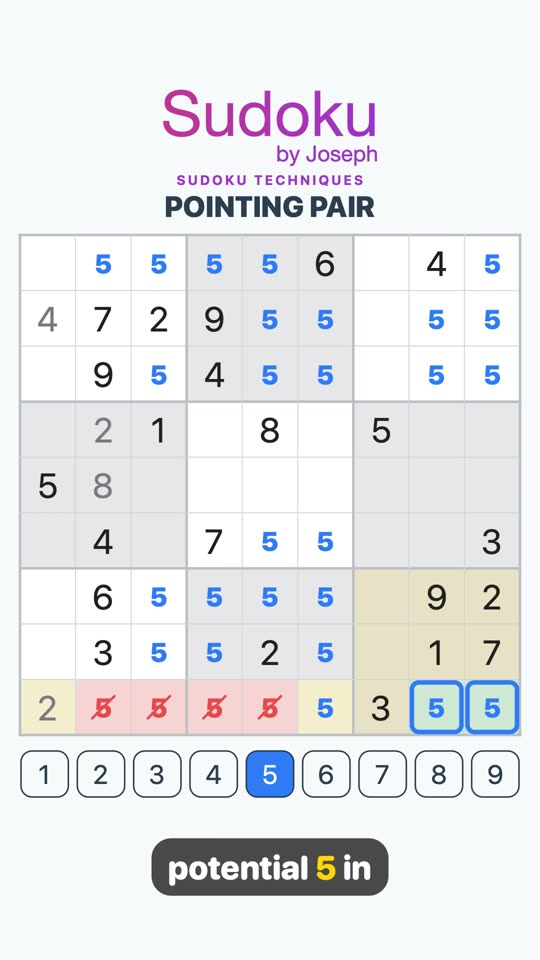
Worked example: the 5 in box 9
The diagram shows a real position with every candidate filled in. Focus on the digit 5 and on box 9, the bottom-right box (rows 7 to 9, columns 7 to 9).
- Step 1: find where the 5 can go in box 9. Box 9 has four empty cells: row 7, column 7; row 8, column 7; row 9, column 8; and row 9, column 9. Only the last two carry a candidate 5. The two cells in column 7 hold no 5 at all.
- Step 2: notice they share a row. Row 9, column 8 and row 9, column 9 both lie in row 9. So the 5 of box 9 sits in row 9, in one of those two cells.
- Step 3: follow the row out of the box. Row 9 can hold only one 5, and box 9 has taken it. Every other candidate 5 in row 9 goes: in row 9, columns 2, 3, 4, 5 and 6. That is five pencil marks in one move.
- Step 4: collect the payoff. Row 9, column 2 had only two candidates, 1 and 5. With the 5 gone, it can only be 1, and you place it.
The board is a real Classic puzzle from Sudoku by Joseph, where Classic has six levels from Casual to Diabolic. The video on this page plays the same position.
The column version, and the mirror move
The same move works vertically. If the candidates for a digit inside a box all sit in one column, that column's copy of the digit is inside the box, and you erase the digit from the rest of the column. In the example above, if the two 5s of box 9 had both been in column 8, you would clear the 5 from column 8 above the box instead.
There is also a mirror image, called box-line reduction or claiming. Here you start from the line, not the box: if a digit's candidates in a row (or column) all fall inside one box, that box must take the row's copy there, and you erase the digit from the other cells of the box. Pointing pair: box first, erase along the line. Box-line reduction: line first, erase inside the box. Both are "intersection" moves, because they use the cells where one box and one line overlap.
Common mistakes
- Erasing inside the box. A pointing pair clears the line outside the box. The two cells themselves keep the candidate; one of them is the answer.
- Missing a third candidate. If the digit also appears anywhere else in the box, even in another row, there is no pointing pair. Check all nine cells of the box, not just the obvious two.
- Working with incomplete pencil marks. If you never wrote a candidate into a cell, you may think a digit is confined to one row when it isn't. Intersection moves are only safe on complete candidates.
- Confusing it with a naked pair. A pointing pair is about one digit in two cells. A naked pair is two cells that each hold the same two digits and nothing else.
How to spot a pointing pair
- Work box by box, one digit at a time
Choose a box and a digit that is still missing from it. Look only at that digit's candidates inside the box.
- Check whether they line up
If all of them sit in one row or one column (two or three cells), you have a pointing pair or triple. If they spread over two rows and two columns, move on.
- Follow the line out of the box
Scan the rest of that row or column for the same digit. Every candidate you find there can be erased.
- Then run the reverse check
For each row and column, ask whether a digit's candidates sit inside a single box. That is box-line reduction, and it catches what the box-first scan misses.
- Look for the single it creates
After each elimination, check the cells that lost a candidate. A cell down to one candidate, as in row 9, column 2 above, is your next placement.
Frequently asked questions
Is a pointing pair the same as locked candidates?
Yes. "Locked candidates" is the umbrella term for both intersection moves. The pointing pair (box first) is often called locked candidates type 1, and box-line reduction or claiming (line first) is type 2.
Can a pointing pair place a digit directly?
No, it only removes candidates. But the removal often leaves a cell with one candidate, as in the example, where row 9, column 2 drops to a single 1.
What is the difference between a pointing pair and a pointing triple?
Only the number of cells. A box row or column has three cells, so a digit can be confined to two or to all three of them. The logic and the elimination are the same.
Which technique should I learn after the pointing pair?
The naked pair and the hidden pair are the natural next steps. Both use the same habit of reading complete pencil marks.
Find your next pointing pair on a real puzzle
12 variants, a Daily Challenge with streaks — and never any lives, coins or energy bars. The download is free.