 English
 Deutsch
 Français
 Español
 Italiano
 Nederlands
 Dansk
 Svenska
 Norsk bokmål
 Polski
 Português (Brasil)
What is a hidden pair in sudoku?
A hidden pair is two digits that, inside one row, column or box, fit in exactly the same two cells and nowhere else. Those two cells must hold those two digits, so every other candidate in the two cells is wrong and can be erased.
It is called hidden because the cells look busy: they carry four, five or six candidates, and the pair disappears among them. You find it by asking about digits, not cells. This guide walks through a real puzzle where one hidden pair removes eight candidates at once, explains how it differs from a naked pair, and gives you a scan that finds it reliably.
- Pattern
- Removed candidate
The logic in plain words
Every column needs a 5 and a 6. Suppose that in one column, the 5 can only go in two cells, and the 6 can only go in the very same two cells. Then those two cells take the 5 and the 6 between them, one each. There is no room left in them for anything else.
So any other candidate in those two cells, a 3, a 7, a 9, is impossible and can go. Notice what this move does not do: it doesn't touch the rest of the column. The 5 and the 6 were already confined to the two cells; the payoff is inside the cells themselves.
The same idea scales: three digits confined to the same three cells form a hidden triple. The pair is far more common and far easier to see.
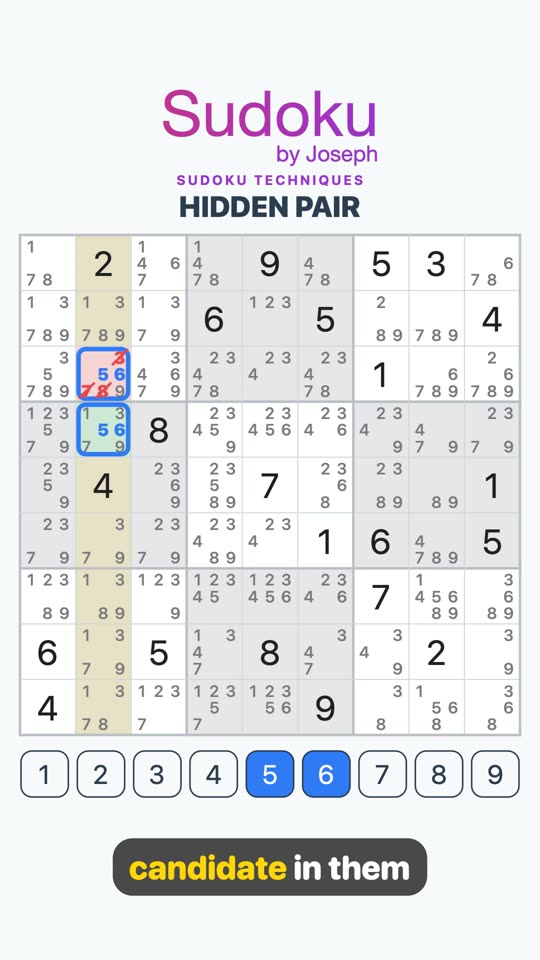
Worked example: 5 and 6 in column 2
The diagram shows a real position with every candidate filled in. Look at column 2, the second column from the left.
- Step 1: count where each missing digit can go. Column 2 already has its 2 (row 1) and its 4 (row 5). Go through the missing digits one at a time. The 5 appears as a candidate in only two cells: row 3, column 2 and row 4, column 2. The 6 also appears in only those two cells.
- Step 2: see the pair. Two digits, the same two cells. Row 3, column 2 and row 4, column 2 must be 5 and 6, in some order.
- Step 3: clear the two cells. Row 3, column 2 holds 3, 5, 6, 7, 8 and 9; the 3, 7, 8 and 9 go. Row 4, column 2 holds 1, 3, 5, 6, 7 and 9; the 1, 3, 7 and 9 go. That is eight candidates in one move.
- Step 4: read the result. Both cells now show only 5 and 6. The hidden pair has become a naked pair, and no other cell of the column had a 5 or a 6 to begin with.
Scanning cells would never have found this: two cells with six candidates each look like nothing. Scanning digits found it in a few seconds.
The board is a real Classic puzzle from Sudoku by Joseph, where Classic has six levels from Casual to Diabolic. The video on this page plays the same position.
Hidden pair vs naked pair
Both moves end with two digits locked into two cells. The difference is where you look and what you erase.
- Naked pair: two cells hold only the same two digits. You erase those two digits from the other cells of the unit.
- Hidden pair: two digits fit only in the same two cells. You erase the other digits from those two cells.
A handy test: if the two cells already show nothing but the pair, it's naked, and the work is elsewhere in the unit. If the cells carry extras but the two digits have nowhere else to go, it's hidden, and the work is in the cells. The two moves are mirror images, and in every unit a hidden pair has a naked counterpart among the remaining cells, which is often bigger and harder to see.
Common mistakes
- Checking only one of the two digits. The 5 alone in two cells isn't enough. Both digits must be confined to the same two cells.
- Erasing the pair digits elsewhere. A hidden pair removes candidates from inside the two cells. Elsewhere in the unit the two digits were already absent.
- Counting across units. The two digits must be confined within one row, column or box. A 5 confined in a column and a 6 confined in a box don't combine.
- Relying on incomplete notes. A forgotten candidate 5 somewhere in the column makes a fake pair. Fill in every candidate first.
How to spot a hidden pair
- Pick one unit
Work through a single row, column or box. Boxes and columns with many empty cells are good hunting ground.
- Count cells per digit, not digits per cell
For each digit the unit is still missing, count how many cells could take it. Write down every digit that fits in exactly two cells.
- Match two digits with the same two cells
If two of those digits share the identical pair of cells, you have a hidden pair.
- Strip the two cells
Erase every other candidate from the two cells. Then check their other units: the pair is now naked and may clear more.
Frequently asked questions
Why are hidden pairs harder to see than naked pairs?
Because the eye scans cells, and a hidden pair lives in cells crowded with other candidates. It only shows up when you count, digit by digit, where each digit can go in a unit.
Does a hidden pair remove candidates from other cells?
Not by itself. It clears the two pair cells. Once it turns into a naked pair, though, that pair can clear other units the two cells share.
What is a hidden single?
The size-one version: a digit that fits in only one cell of a unit. That cell must take it, even if it shows other candidates. A hidden pair is the same idea with two digits and two cells.
Hunt hidden pairs on real puzzles
12 variants, a Daily Challenge with streaks — and never any lives, coins or energy bars. The download is free.