 English
 Deutsch
 Français
 Español
 Italiano
 Nederlands
 Dansk
 Svenska
 Norsk bokmål
 Polski
 Português (Brasil)
What is a naked pair in sudoku?
A naked pair is two cells in the same row, column or box that hold the same two candidates and nothing else. One of the cells gets the first digit, the other gets the second. You don't know which way round, but either way both digits are used up, so you can erase them from every other cell of that row, column or box.
It is one of the most common moves once a puzzle gets past the singles, and it is easy to see once your pencil marks are complete. Below: the logic in plain words, a real puzzle where one naked pair removes eight pencil marks and creates two singles, the difference from the hidden pair, and a routine for finding it.
- Pattern
- Removed candidate
The logic in plain words
Take two cells in one column whose candidates are exactly 2 and 4. The first cell must be 2 or 4. So must the second. They can't both be 2 (a column holds one 2), and they can't both be 4. So one is 2 and the other is 4.
That settles where the column's 2 and 4 go: inside these two cells. No other cell of the column can be 2 or 4, so those candidates are wrong everywhere else in the column. You remove them without knowing which cell gets which digit.
"Naked" means the pair is visible on the surface: the two cells show only the two digits. The same idea grows to a naked triple (three cells whose candidates together are only three digits) and a naked quad, but the pair is the version you will meet most.
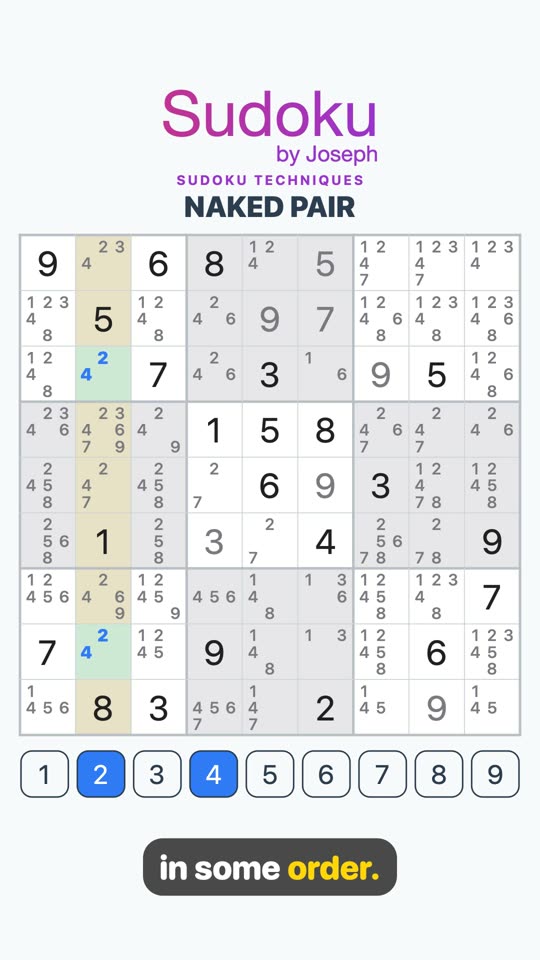
Worked example: 2 and 4 in column 2
The diagram shows a real position with every candidate filled in. Look at column 2, the second column from the left.
- Step 1: find two cells with the same two candidates. Row 3, column 2 holds only 2 and 4. Row 8, column 2 also holds only 2 and 4.
- Step 2: draw the conclusion. One of these cells is 2 and the other is 4. Column 2's 2 and 4 are spoken for.
- Step 3: erase 2 and 4 from the rest of column 2. The other empty cells of the column are row 1, row 4, row 5 and row 7. Each loses its candidates 2 and 4: eight pencil marks in one move.
- Step 4: collect the singles. Row 1, column 2 had 2, 3 and 4, so it is now a 3. Row 5, column 2 had 2, 4 and 7, so it is now a 7. Row 4 keeps 3, 6, 7 and 9, and row 7 keeps 6 and 9.
The two pair cells sit in different boxes (box 1 and box 7), so the elimination only runs along the column. If both cells shared a box as well, you could clear 2 and 4 from that box too.
The board is a real Classic puzzle from Sudoku by Joseph, where Classic has six levels from Casual to Diabolic. The video on this page plays the same position.
Naked pair vs hidden pair
The two names sound alike and describe the same end state, two digits locked into two cells, but you find them from opposite directions.
- Naked pair: you look at cells. Two cells contain only the same two digits. You erase those digits from the other cells of the unit.
- Hidden pair: you look at digits. Two digits can only go in the same two cells of a unit, but those cells hold other candidates too. You erase the other candidates from those two cells.
A hidden pair becomes a naked pair the moment you clear its extra candidates, which is why the two are often learned together.
Common mistakes
- Pairing cells from different units. Two cells with 2 and 4 only form a naked pair if they share a row, column or box. Two such cells far apart prove nothing.
- Accepting a third candidate. A cell with 2, 4 and 7 is not part of a naked pair with a 2/4 cell. (Three cells holding only 2, 4 and 7 between them would be a naked triple.)
- Erasing in the pair cells. The pair cells keep both candidates. Only the other cells of the unit lose them.
- Forgetting the shared box. When the pair also sits in one box, the box elimination is a second, separate payoff that many players miss.
How to spot a naked pair
- Fill in complete pencil marks
A naked pair is only visible when every candidate is written down. Gaps make random cells look like pairs.
- Scan for two-candidate cells
Cells with exactly two candidates stand out. Note them as you sweep the grid.
- Look for a twin in the same unit
For each two-candidate cell, check its row, column and box for another cell with exactly the same two digits.
- Clear every unit the pair shares
Erase both digits from the other cells of the shared row or column, and also of the box if both cells sit in one. Then check those cells for new singles.
Frequently asked questions
Does a naked pair have to be in a row or column?
No. Any unit works: a row, a column or a box. If the two cells share both a line and a box, you can clear both units.
Can a naked pair place a digit?
Not directly. It only removes candidates. In the example, though, those removals leave row 1, column 2 with a 3 and row 5, column 2 with a 7.
What is a naked triple?
Three cells in one unit whose candidates, taken together, are only three digits, such as 2/4, 4/7 and 2/7. Not every cell needs all three digits. Those three digits go from the rest of the unit, just like with a pair.
Spot naked pairs on real puzzles
12 variants, a Daily Challenge with streaks — and never any lives, coins or energy bars. The download is free.